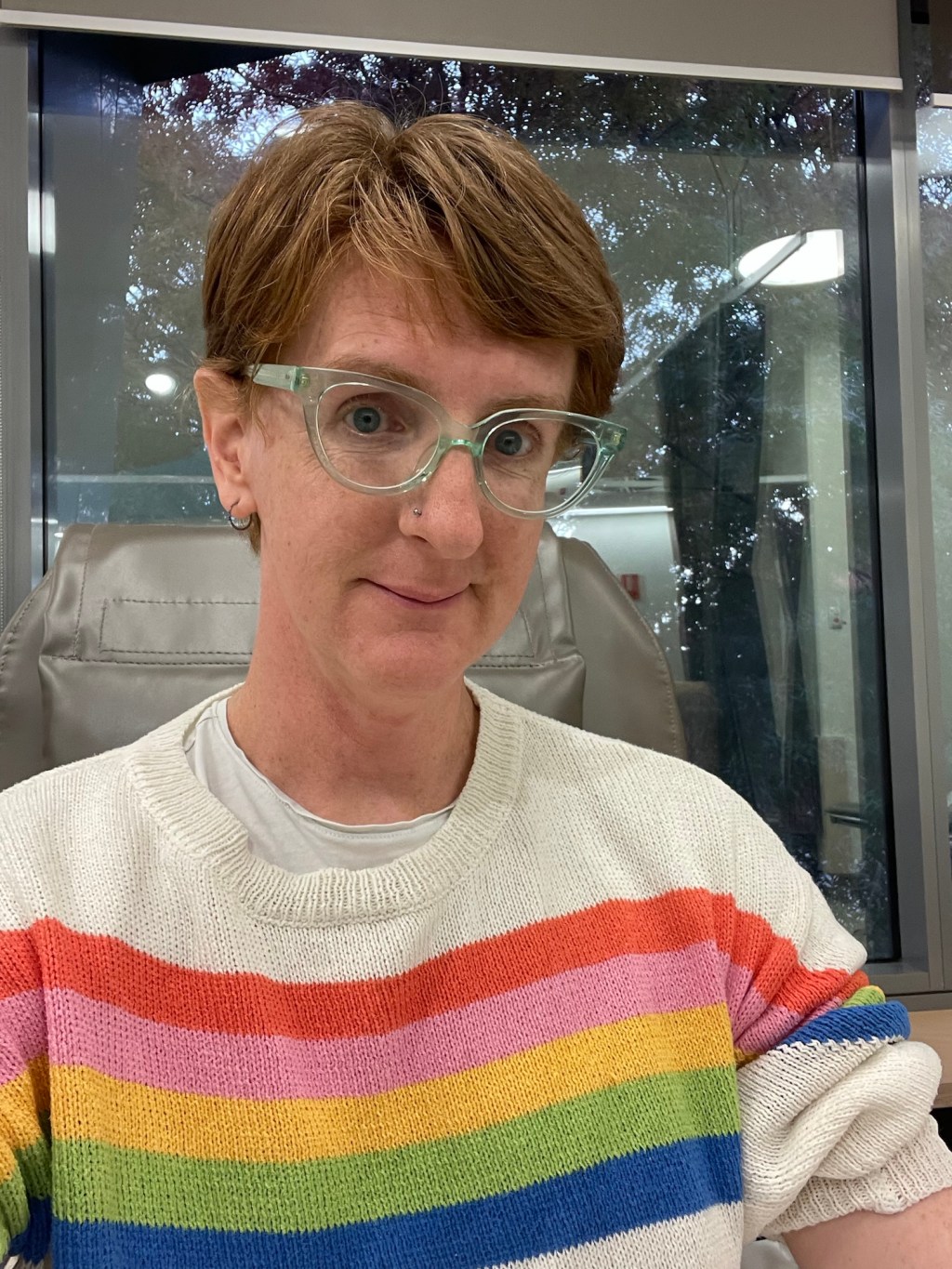
Getting a cancer diagnosis is rarely fun. But when I got my first, 10 years ago almost to the day, it didn’t really mean anything to me. Surgery was swift and necessary, so it happened, and I had so little care for my pre-transition self that it had all the emotional weight of a mechanic telling me my transmission needed replacing.
The second time around couldn’t have been more different. First, because I didn’t expect it – I’d been regularly monitored for 7 years post-surgery with nary a blip, so I thought cancer was a thing of my past. Clearly it had different ideas though; some tiny cluster of persistent cells worked in the darkness to survive, to thrive and eventually build enough mass that I went to the hospital. No one there thought it was serious at the time – likely an abscess on a muscle, or maybe a kidney infection. The answers were vague, and cancer was checked as a formality, but only that – a box to be ticked to cover the bases.
So it was a rude shock when I went in expecting to maybe get an abscess drained and be sent away, only to be told that my cancer had lain dormant and unnoticed for 10 years, and had slowly gathered an army in my lymph nodes.
I didn’t care about myself when I was first diagnosed, and though I’ve made some progress there, I still struggle with that. But the big difference is that I have a Bug now – her plans for arrival into the world were revealed mere weeks after my surgery, and now she’s a fully sentient, loving, imaginative, vulnerable child. The thought of having such a serious illness, one that might forcibly remove from her life after I have worked so hard over the last few years to be an active part of it… I literally couldn’t think of anything scarier or more upsetting.
That news was softened by a pretty decent prognosis – as my oncologist agreed, this is perhaps the best cancer to have (if you have to have cancer). It’s aggressive, but we’ve caught it before it’s run wild, and it’s highly responsive to treatment, so a single 3 month course of chemotherapy has a 90% treatment rate, so I’ll likely see the end of the year with a clean bill of health (with the asterisk of yet-more monitoring, but I guess that’s a small price to stay alive).
The existential intensity settled a bit given that news, but a diagnosis like this, especially one so culturally-loaded as cancer, has and continues to take its toll on me. Over the last few weeks, cancer has taken over my identity – my gender is Cancer, it’s an asterisk at the end of my job title… everything I do revolves around some annoying clusters of hyper-replicating cells in my back. I imagine this happens to most cancer patients to some extent, being that cancer is a condition of such medical and cultural gravity that I doubt many people escape that downward pull.
But it hit an already sore-spot for me, struggling as I have to build a sense of identity in the last few years. Processing a major breakup, starting medical transition, trying to recover from the damage of childhood… all of these are the sort of life events that scour you back to zero and force you to build anew. And that can be a very healing process, at it has been for me, but it’s much harder when you’re in a conservative regional town that is not receptive to your people, and you don’t know anyone. I’ve struggled to put down roots up here, and, aside from the joyous role of Bug’s Parent, I don’t feel connected to much of anything. When I walk away from my work laptop at the end of a day, I often feel like an NPC while the protagonist is out of town, or a robot with no assigned duties – simply disconnected. Now, before you say it, no I know that’s not healthy and I have been trying to find ways to connect with people up here, but it is slow going, and I feel adrift in my own company.
So when that already-faint identity is hit by the combo-multiplier of a serious medical condition, one tends to spiral – or at least, I know I did, and probably will again. I wished I had someone closer, someone who I could lean on as a sturdy reference point while my rogue cells try to take over my body and my self. There are lots of therapeutically-actionable reasons why I’m not in a relationship and struggle to make friends, but this isn’t the time to suddenly overcome those, and a new relationship would probably just act as a force-multiplier anyway.
So I despaired, and not with any great subtlety. I’ll note here that I do have some supports, and I do not mean to devalue them, but the geographic isolation has always made that connections harder to lean on, and in this case, we do our best and I appreciate it all, but that can only be so much.
In a moment of clarity disguised (to me) as a pragmatic communications solutions, was a group chat to keep interested people updated with my medical news. Because I still genuinely forget to care about myself and tend to extrapolate that to everyone else, I didn’t think of it as a support network at the time – it truly was about telling the most people with the least effort, at least as far as I conceived of it.
In that way that good ideas are still good even if your motivations are out of whack, that group chat turned out to be a lifesaver (not medically, obviously, or I wouldn’t be in the process of getting strategically poisoned right now, but I trust you understand metaphor). You, a person who is not me, will be SHOCKED to know that I have people in my life who care for me, and putting a good chunk of those folks in one place made it harder for my brain, which tends to try and Matrix bullet-dodge anything that could constitute care for me, struggled to avoid it. Here were a bunch of kind and lovely people, chatting away because some of my cells won’t stop growing. It wasn’t a magic cure, but it was the beginning of the frankly confronting experience of accepting care.
Without turning this into a therapy session, being a helper is deeply engrained in my sense of self, and for the most part, I like and accept that about me. The only tricky part is that I am so invested in being the helper that I struggle to be helped. So my very patient friends have sat through me ping-ponging between “I don’t know if it’s worth you coming?” and “Maybe it would be good?” as I try to sort my emotional responses into ‘healthy and worth listening to’ and ‘maybe not the script we need right now’. And I appreciate the general persistence my friends have shown, because they have been proven right – having folks close by has been a relief not just for practical things, like knowing that I have backup for Bug, but also for helping me preserve some sort of identity that’s not wholly defined by my medical condition. Having old, dear friends around helps me remember the parts of me that exist outside of the hospital system, the Gin who has meaningful connections to other people that I am prone to forgetting when time and distance wear on me.
Reaching out to friends and accepting their help is also a confronting process, but it’s a healthy challenge, and arguably one that was long overdue. It’s been proven to me in no uncertain terms that being so vigilantly independent, not relying on anyone or allowing them to care for me, is another habit that makes it harder to form those deeper connections that I crave. Rationally, I know that vulnerability is a key part of an expanding relationship, but this phase of my life is smacking me in the face with the emotional value of making myself vulnerable. Does that mean I’m good at it? Oh Lord no! There’s still part of me that’s trying to reassert my independence, that I can do things for myself in direct proportion to the care I receive, but the cumulative nature of the treatments I’m receiving will mean that I’ll probably have to surrender even that final bit of defiance once I’m in the late phases.
It seems like the height of Pollyanna behaviour to find a silver lining in such a grim situation, and honestly I would’ve preferred it were all a bit more gentle. But sometimes when you’re really stuck in a rut, it takes a big push to shake you out of it, and get you back on the path you need.


Leave a Reply